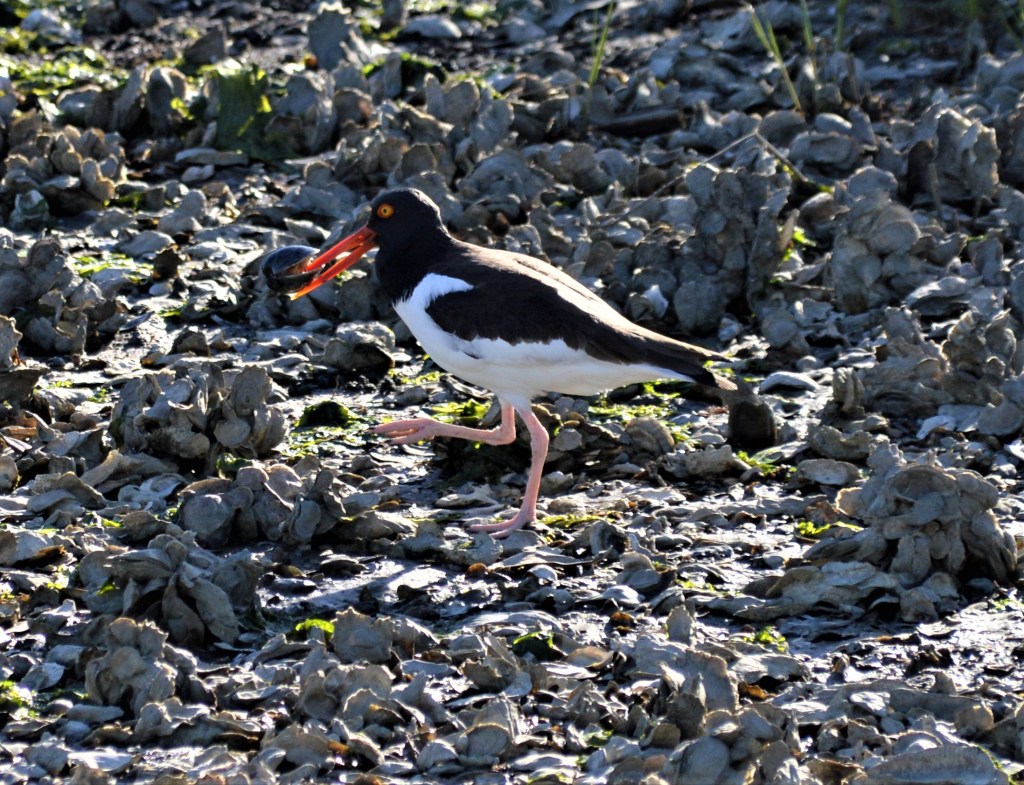
Often seen while boating in Charleston, the American oystercatcher (Haematopus palliatus) is a distinctive and charismatic shorebird native to coastal regions of North and South America. Known for its striking appearance, it features a long, orange bill, black head and back, and white underparts. Its eyes are surrounded by a bold yellow eye-ring, further adding to its distinctive look. The legs are pink and the eyes are yellow.
This bird primarily inhabits coastal beaches, mudflats, and salt marshes, where it forages for food along the shoreline. As its name suggests, the American oystercatcher primarily feeds on bivalve mollusks like oysters, clams, and mussels. It employs a specialized feeding technique to access these shellfish. Using its long, sturdy bill, the oystercatcher probes into the sand or mud, feeling for buried prey. Once it detects a shellfish, it will hammer its bill into the shell, using its powerful muscles to pry it open. This feeding behavior requires both strength and precision, as the oystercatcher must contend with the often tightly sealed shells of its prey.
In addition to bivalve mollusks, the American oystercatcher also feeds on other invertebrates found along the shoreline, including crabs, worms, and small crustaceans. It may also opportunistically consume fish and marine worms.
Overall, the American oystercatcher plays an important ecological role in coastal ecosystems by helping to control populations of bivalve mollusks and other invertebrates. However, like many shorebird species, it faces threats from habitat loss, human disturbance, pollution, and climate change, making conservation efforts crucial for its long-term survival.

 Birding by Boat Charleston